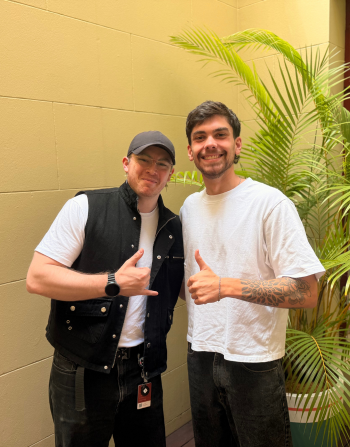
For the second year running, Codex Consulting has been named among the finalists at the Australian AI Awards, with Jacob Campbell and Lucien Koefoed shortlisted in 2026.
Codex Consulting has two finalists at the Australian AI Awards 2026: Jacob Campbell in AI Rising Star of the Year (SME) and Lucien Koefoed in AI Software Engineer of the Year. It’s the second year in a row Codex has been represented among the finalists.
Ahead of the gala on 30 October 2026, both finalists sat down to talk about the work behind their nominations, what the recognition means to them and where they see AI heading.
Meet Jacob Campbell, AI Rising Star of the Year (SME) finalist
If you had to explain to someone outside the industry what you were nominated for and why it matters, how would you describe it?
It’s about someone who has had a really big impact in AI despite being a relative newcomer to the industry.
For me personally, that matters because I’ve only been working in AI for around 18 months. In that time, I’ve had a really big impact on a couple of key projects, which have helped not only our customers, but the people who interact with them every day.
You spent your first few years at Codex working across various business units before shifting into AI and ML engineering about 18 months ago. What prompted that transition?
I spent my first 3.5 years at Codex working across various internal processes, with varying levels of enjoyment and success. I found the most enjoyment when I started doing customer work, in data science and data analysis. I did that for about 2–3 months, then drove straight into AI from there.
That drive came from knowing I needed a fast-paced environment. Consulting is already fast-paced, but AI takes it to another level, and the workload expected from a relatively small team really excited me. I’m the type of person who wants a new challenge every so often; I can get bored doing the same thing repeatedly.
AI gives me what I want from my work life: satisfaction, and seeing my work impact customers at a really fast pace, across multiple industries and environments. That’s what drove the move, and I’ve found a lot of success in it.
Your nomination mentions an agentic validation framework you engineered. For someone who isn’t deeply technical, what does it do and why was it important?
This was work for a customer that wanted to use its raw data to surface operational insights. The first step was a big discovery process: understanding what types of data they had, and how it could be presented to the end user. That shaped the rules and requirements for the workflow.
The framework takes around 7,000 raw data points at roughly a 30-second cadence. It ingests and restructures that data so an agent can generate predictions and insights from it autonomously. It’s a 7-layer system that turns raw data into business-ready data – and it’s not just a data transformation workflow. It also runs prediction models and other generative AI and machine learning processes.
It needed 7 layers because at every point in the transformation, the data being transformed and presented had to be evaluated and validated. It took roughly 6 weeks to build. Over a 6-month period, it generated 52 unique insight types and spotted around 2,000 issues.
You went back to your former high school to co-deliver an AI business development program for senior students. What motivated you, and what surprised you about working with that group?
By then I’d had roughly a year’s experience working in AI. The two leaders of the program wanted someone with recent experience, who had just made that transition, to help the students understand it without it being too technical.
What surprised me was the general appetite for getting better at using these systems. They’re students, so of course they want AI to help them at school. But there was a real appetite for learning exactly how to use it properly.
When you work in AI every day, it’s easy to overestimate how much the average person understands about it. These students were intuitive, understanding and really eager to learn the right ways of using AI.
Meet Lucien Koefoed, AI Software Engineer of the Year finalist
In your own words, what sets your work apart in the AI software engineering space?
It’s stepping away from the habits I most easily fall into, which is being the lone wolf. Instead, I’ve focused on taking as much of what I’ve learned as possible and bringing as many people as possible on the journey.
I could make myself 30x, 50x, whatever. But what I’ve been able to do over the past 8 to 10 months is multiply the capability of most of Codex by 2x, 3x, even 5x.
Can you talk about a project from the past year that best represents why you’ve been recognised?
One of the best examples is a recent project building a digital twin for a large, multi-billion-dollar company, along with a new way for its customers to interact with it. It’s as much a website change as it is a marketing tool, and it’s almost recognisable as an independent agentic interface – leading on to agentic commerce.
Each of those pieces is interesting and impactful on its own. But the reason it’s worth recognising is that we’ve delivered it with a fraction of the people and resourcing the customer was expecting. We’ve been able to do that precisely because the techniques and approaches I’ve proposed, developed and shared across the teams have made us so ridiculously effective.
How do you think about the balance between building something technically impressive and building something that delivers value for the customer?
For us, if it doesn’t deliver value, it doesn’t matter in the slightest how impressive it is.
Even the more difficult parts of software engineering are – I wouldn’t say automated, but certainly easier than they used to be. The hard part now is understanding how what you’re building will deliver immediate and ongoing value to a customer, and then making sure that value actually lands, not just at delivery but long after.
As much fun as stochastic compiler optimisation might be, no one cares if it doesn’t move the needle. And they shouldn’t.
Where do you see the role of AI software engineering heading over the next few years?
The human element in software engineering is certainly going to be different, and most likely quite minimal. Even now, if you’re careful with the setup and impose relatively stringent but mechanically verifiable standards, the only real reason to have a human engineer in the process is to make sure what’s being built actually delivers customer value.
Almost everything about how it’s built – the testing, the layout, the architecture – is a decision you only need to make once or twice every 20 to 30 projects, because a lot of software is basically the same thing over and over again. Over a 3–5 year horizon, I’d honestly expect the majority of technically focused knowledge workers to no longer be necessary in that process, and to transition into something that looks more like a product manager role.
In their own words
How did you find out you’d been named a finalist, and what does it mean to you to be recognised at a national level?
Jacob: I found out after receiving a call. To be honest, I was quite shocked. I was hopeful I’d be selected, but it’s always nice to be recognised.
Seeing how much impact I’ve been able to make, even without a nomination, has given me pride and confidence in what I can actually deliver. The nomination itself is almost a hallmark of that work growing into something that can be recognised. So, yeah – immense pride.
Lucien: I was walking down to the supermarket to grab a late-afternoon pick-me-up when I got the call. I was delighted. It’s a nice thing to stroke the ego a little bit. My next thought was whether anyone else from Codex had been nominated too – and they had, so I was very pleased about that.
Where do you think AI will be in 3–5 years?
Jacob: To say working with AI has been transformational would be an understatement. As I’m sure everyone sees in their day-to-day use, it’s evolving at an almost scary pace. So where it’ll be within 3 years, let alone 5, I honestly couldn’t tell you.
But I think we’re heading towards a future where we interact with AI through voice rather than messaging. There’ll be a lot of autonomous work done by agents, without any physical setup. Especially as transcription and voice recognition get better, I don’t see much need to use our hands to type anymore.
Lucien: Honestly, I’m not sure either. Humans are pretty good at predicting linear things, but AI isn’t linear. You can argue it’s on the exponential part of an S-curve, but it’s still exponential.
In the last 12 months alone, it’s gone from an invaluable assistant to something that, if you set it up right, gives you automated software factories producing a quality no one I’ve ever met could sustain – let alone at that pace.
This is the second year in a row Codex has had finalists at the Australian AI Awards. What does that say about the work happening here?
Jacob: It says a lot about the depth of knowledge and expertise here, and the general will to provide a really, really good service for our customers. It also shows our consistency. We’ve grown significantly, but we haven’t become complacent. We’ve grown with the right people, and we’ve expanded our knowledge and ability to deliver quite drastically without compromising the quality of our work.
And it’s not just the AI side of Codex. Across data and digital, there’s a wealth of expertise and a commitment to consistently doing really good-quality work for our customers – and that hasn’t dropped off. It’s good to be part of that, and to be a driving force of it, especially as a rising star.
Lucien: Codex started off as a boutique, fairly general software consultancy. Over the past 2–3 years especially, it’s leaned into data and AI specifically, because those are the things that drive real change. And consistently, we’re finding that to make the biggest changes, and deliver the kind of ROI people actually need from their upfront investment and ongoing costs, we need to be at the leading edge – or driving it.
Gala night
What are you most looking forward to on the night itself?
Jacob: Celebrating the achievement with everyone else at Codex. There’ll be around 10 of us going, and it’ll be great to spend time together outside office hours and enjoy a couple of really good achievements, not just mine but Lucien’s as well.
Lucien: A couple of things. One is easy: the food! The other is the conversations with other attendees. Brodie went last year, and for him one of the most valuable parts was sharing ideas with people who are genuinely enthusiastic about the subject.
What would it mean to you to win?
Jacob: Honestly, it would just be an extension of being nominated. I’m already really proud to have been nominated, and being able to go and celebrate with the team and the people close to me will be meaningful enough. But I love to win things. If I do, I can’t say I won’t be really happy, really proud and very much showing off the achievement!
Lucien: To me, winning would be a validation of the continual drive that I’m making, and that Codex in general is making, to get the most out of this technology and these approaches that we possibly can. And of consistently not taking the easy path simply because it’s there. A focus on customer obsession, as trite as that might sound.
The Australian AI Awards 2026 winners will be announced at the gala on 30 October 2026. Follow Codex on LinkedIn to see how Jacob and Lucien go.
Talk to Us
We would love the opportunity to connect and understand more about the problems you are trying to solve.


Megan Waldon
Associate Partner

Get in touch to coordinate a meeting with one of our technical experts.
Australia: +61 7 3132 3002.